Showing posts with label cotton. Show all posts

Wednesday, 3 April 2013

Color Development with Natural Brown Cotton

Two skeins of darkened Brown Pima cotton handspun yarn;
atop the skein on the right are a few strands of the original Brown Pima handspun


Starting with Easy To Spin Brown Pima cotton sliver, I produced my first two handspun skeins of naturally colored brown Pima cotton yarn to be used in weaving.

I have learned that, over time, naturally colored brown cotton gradually darkens when subjected to repeated washing with detergents and heating in a dryer, that is, when subjected to moisture, especially in a basic pH environment, and to heat. I decided to do some Color Development, as Sally Fox describes this process for intentionally darkening naturally coloured cotton.

Following one of her suggestions, I added 2T of baking soda (sodium bicarbonate) to a gallon of water and added those two skeins of handspun brown Pima cotton. As the pot came to a boil, I kept pushing the yarn beneath the surface of the water until it was completely saturated and stayed immersed. I boiled the pot for 30 minutes.

Not only did the brown color darken, but on drying, the yarn has lost some of its sheen and has a matt appearance. I like my transformed skeins of dark brown cotton. I find a growing interest in the history of colored cotton, as described by James M. Vreeland, Jr. in the linked article published in the Scientific American in 1999. Equally fascinating is the Sally Fox story: Innovation in the Field.

No matter how interesting it is to learn new things, nothing beats the pleasure of a simple head scratch.


Post by M in JaM
Pix by JaM

Monday, 25 February 2013

Plying Cotton


Some handspinners recommend that, when plying yarn, you set your lazy kate holding the bobbins filled with singles as far from your spinning wheel as possible. The resulting long run allows the twist in each single to become more evenly distributed.

Plying set-up for three bobbins:
from bobbins on lazy kate; through eyelet-guide; to wheel in foreground;
sorry about the unmade bed; housework has low priority.
I've been wanting to try this with my handspun cotton, but the long run from lazy kate to wheel worried me as I could imagine the two singles bumping into one another and getting tangled whenever I paused during the plying process. I also worried that the dog, Jerry or me would forget and walk into the path of those almost invisible threads strung across the room for a day or more as I can never seem to finish plying a batch of cotton in one day. Perhaps one day I'll develop calluses necessary for running all that yarn through my fingers in one session.

I decided the best solution to the dog and thoughtless walker worry was to move my spinning wheel and accessories upstairs where there is less traffic. The hot temperatures have eased during recent overcast days and that makes working upstairs possible.

Jerry solved my tangled yarns worry by handing me a strip of smooth wood that held a set of evenly spaced eyelet-screws. I clamped the wood strip to a chair placed midway between the lazy kate and the spinning wheel. I tested this plying set-up with two bobbins of cotton singles, threading each single yarn through an eyelet. The long run to the wheel made it easier for me to coax any remaining twisty areas into plying with surprisingly little effort. The singles did not tangle whenever I released my hold while sitting at the wheel. I feel so delighted with the resulting 2 ply cotton.

Having gained courage by this success, I set up next to ply from three bobbins. I am thrilled that things are going so well with this 3 ply cotton and hope to finish that plying work today.

Toy Creek, February 2013
Meanwhile, the water in the creek looks good though it is not exactly abundant. We usually get 200mm (8 inches) rain in February. We've had ~92mm (~3.7inches) this month which has only three more days until the end of the month. Today the sky is crystal clear. It may get too hot to work upstairs....

Cyclones and flooding are not unusual during the Wet Season in our region, but this year we've had neither... so far. Instead the floods and winds are showing up in southeastern Queensland and into New South Wales, with houses in Sydney losing roofs. Yes, we live in Interesting Times. I find comfort in focusing on areas I can control to some degree, like making things with my hands.

Post by M in JaM
Photos by J in JaM

Sunday, 17 February 2013

Wool and Cotton

Handspun 2ply wool; light fingering weight;
one single is handpainted "Strelitzia" from Kathy's Fibres
one single is Dreamee Wool in Grey from Bilby's Yarns. 

As a spinner, knitter and weaver, I love feeling that initial surge of creativity... then get oh so cranky when I find myself frustrated because all my spinning wheel bobbins are partway full of various unfinished spinning projects, all the knitting needles of a particular size that I need are holding unfinished knitting projects, or that all the weaving bobbins are partially filled with perfectly good (for something) yarn remnants from my last weaving project.

So it was that I got excited about the arrival of new coloured cotton to spin (a Christmas prezzie). I searched high and low, upstairs, downstairs and in the Shed for empty bobbins for my spinning wheel. I tracked them all down, only to acknowledge, that yes, all bobbins were in use – holding hibernating spinning projects. And I wasn't willing to wind off the yarn. After much fretting, I zeroed in on two bobbins, each containing a single of Strelitzia, a handpainted wool from Kathy's Fibres that I spun during Ravelry's Tour de Fleece 2012. I wanted to ply this yarn, but decided I'd make the handpainted singles go further by plying with a completely different yarn, which I would now have to spin.

I picked Grey Dreamee Wool (from BilbyYarns), a Melanian wool (natural colours) from West Australia. The beautifully prepared wool top is a pleasure to spin. The time slipped by effortlessly as the fibres flowed through my fingers. I let the finished singles rest on the bobbin for a couple of nights, then plyed with ease. As soon as I wash the skeins, I can count this spinning project complete... and a success!

Two kinds of naturally coloured cotton
The empty bobbins began calling for the cotton. Above, on the right, you can see "CafĂ©," a certified organic cotton from South America (available at Virginia Farm Woolworks) that I'm spinning on a support spindle. To the left, on a spinning wheel bobbin, you can see Easy To Spin Pima Brown cotton from Cotton Clouds. I so enjoy spinning these coloured cottons. 

The excitement of each beginning evolves into a soothing practice that includes transforming frustration into perseverance. I continue to learn about the satisfaction of finishing.

Post by M in JaM
Photos by J in JaM 

Tuesday, 23 October 2012

Cracklings

 Pattern weft: my 2 ply handspun cotton (spun from Easy To Spin Pima cotton top)
Warp: golden cottolin; crackle weave threading with summer winter treadling

My motto: I live life slowly.... (exceptional efforts exist on twin-sitting days). As the weather heats up, I slow down even further. But... I do find that small, steady efforts - even at a slow pace - yield results.

Band: blue pearl cotton pattern weft on golden cottolin warp;
crackle weave threading with summer winter treadling
I completed the finishing processes on my experimental woven samples: two narrow bands and two table runners. They are hemmed and washed. The table runners are not very long. Perhaps I should call them table loungers. The length looks good on my table.

Table runner: patterns wefts: blue pearl cotton and Heirloom 8 ply cotton in yellow;
golden cottolin warp; crackle weave threading with summer winter treadling

I feel very happy with the look and feel of the samples, especially the one I wove with my handspun cotton as weft. I feel encouraged to keep spinning cotton yarn and start planning next winter's weaving project: more cotton fabric, perhaps handspun weft with fine commercial cotton warp?
Table runner. Pattern weft: my handspun white Pima cotton 2 ply;
Warp: golden cottolin; crackle weave threading with summer winter treadling 
I haven't yet completed the finishing (sewing and washing) processes for the two main woven pieces from this project. I bought blanket binding for their edges, but forgot matching thread. I managed to find a small amount of almost matching thread in my thread box, located my magnifers and a torch, borrowed a screwdriver from my husband and set about figuring out how to adjust the bobbin tension on the sewing machine. Success! I sewed the binding on one end of the woven fabric and promptly ran out of thread. No more sewing until we make another trip to town. Once I have thread, I'll sew in the cool of the morning as it's getting too hot to sew in the shed under the tin roof.

Without air conditioning during tropical summers, we have a few cool hours in the morning to get energetic things done, as well as anything else that requires thinking. Then the increasing heat slows body and brain. We don't fight it. Only mad dogs and Englishmen go out in the mid-day sun.

Post by M in JaM
Photos by J in JaM   

Sunday, 7 October 2012

Houston, do we have a Problem?

Take me to your leader....
Look who has landed: gorgeous harlequin beetles... but hard on hibiscus, right? I'm torn between doing the “right thing” to protect the hibiscus and doing nothing because the beetles look so dazzling. I guess that's one of the reasons I don't qualify as a gardener. I have to remind myself that I have other good qualities.

Avoiding the decision about the beetles, I cut the fabric from the loom. Now I look at the loom and know it's empty even though it's covered to protect it from dust and bat droppings. That's the way it shall remain until cool weather returns. The finishing process for the woven pieces has begun. I've threaded the treadle sewing machine, a Singer 328P, and begun sewing beside the cutting lines of each woven piece (six pieces, counting four samples). Each will be hemmed by hand and washed.

experimental band in commercial cotton and cottolin
This is my first unwashed but hemmed sample, a narrow band with four picks of crackle weave in the centre surrounded by plain weave. I squeezed this piece out of the very last of the warp, coaxing the shuttle through an ever-narrowing shed. I'm pleased with the result. Warp: cottolin. Weft: cottolin, pearl cotton and unmercerized cotton.

Kookaburra's fierce regard
A kookaburra has been coming regularly to the bird bath. He keeps a sharp eye on things. The little birds stay out of his way. Even snakes take heed. Is it too much to hope that the kookaburra might like to eat hibiscus beetles?  

Post by M in JaM
Photos by J in JaM

Sunday, 30 September 2012

Mining Update


My apologies for not posting last week. A gastro bug/virus laid me low... again. What a year!

A Land Court mediation hearing between Monto Minerals subsidiary Baal Gammon Copper and concerned residents of the Walsh River community regarding the proposed mining venture (behind our home) was held last week in Herberton. 

Save the Walsh FNQ has released the following statement:
“It was a fantastic outcome for the local residents of the area, we all feel it has been a real win, “ said group spokesperson Holly Richardson.
“We cannot divulge the full details of what was agreed upon, because of a confidentiality agreement but we can say the new proposed lease has been adjourned and absolutely nothing further in regards to the new mine can proceed until the next mediation with local residents in February/March 2013. 
This mediation will take place after the next wet season, giving Kagara and Monto Minerals the chance to prove that they can work together to address the current issues of environmental harm as demanded to be rectified in the three Environmental Protection Orders issued against them.”
Meanwhile, back at my loom, I've finished weaving the planned projects and there's not much warp remaining so I've been experimenting. Most people do samples at the beginning of their warp. I find myself doing samples at the end. 

Crackle weave threading with summer/winter treadling.
Sample: handspun white Pima cotton 2 ply weft on cottolin warp

One of my small samples has my handspun white Pima cotton (2 ply) as weft. I'm delighted with the look of it. How much the sample shrinks during the finishing process remains to be seen.

Close up shows some variation in grist of cotton weft, but not a real problem
Now that I'm feeling some energy again, I expect to reach the end of the cottolin warp tomorrow and cut it from the loom. That will mark the end of my weaving-on-the-loom season until cool weather returns next year.

Post & Photos by M in JaM

Monday, 23 July 2012

Tour de Fleece 2012 results

I completed the Tour de Fleece in Ravelry for the first time, achieving my goal of spinning a little every day (except rest days). Team members helped keep me motivated and I am pleased as punch with my results: a skein of 3 ply wool and a skein of 2 ply Pima cotton.

Hand-spinning wool for Tour de Fleece 
I used my Ashford Traditional wheel to spin handpainted wool top from Kathy's Fibres in the "Strelitzia" colourway. Kathy's coloured wool top is a joy to spin. I used Sarah Anderson's technique for Navajo plying to produce a 3 ply yarn with a grist of 2700m/kg. I found Sarah's technique works best for me when I place the lazy kate (holding the full bobbin of single) on the floor beside me.

Hand-spinning cotton for Tour de Fleece
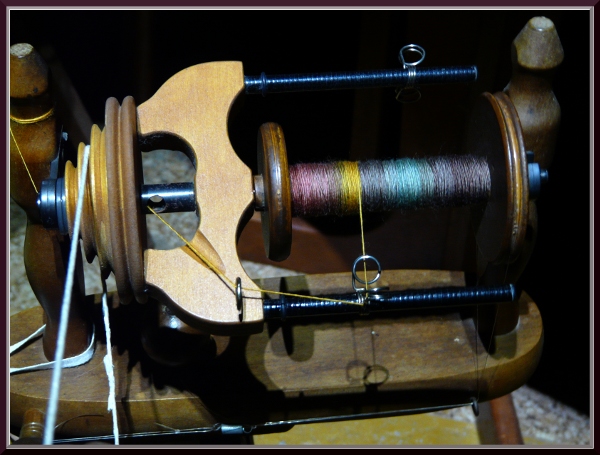
Using Easy To Spin Pima cotton top from Cotton Clouds, I did a little spinning with a support spindle but mainly I used my Ashford Traditional wheel. I have grown ever more confident at spinning cotton on the Ashford. I did discover that I prefer spinning a cotton single onto a fat core bobbin.

Cotton single (top) on regular bobbin;
cotton single (bottom) on fat core bobbin.
Equal amounts of cotton on each bobbin.

Now that the Tour is completed, I really must do something about all those dust bunnies that have accumulated in the corners since housework fell off the priority list....

We had a grand time with the twins last week.


On the way home we saw a double rainbow over Mareeba. Handcraft activities make me happy. So do grandchildren and rainbows.


Post by M in JaM
Pix by JaM

Tuesday, 10 July 2012

Busy Hands


Handspinning cotton on Ashford Traditional wheel and on JaM support spindle
as participant in Tour de Fleece.
~Easy to Spin Pima cotton top from Cotton Clouds~

Craftwork continues as my primary focus these days. I'm meeting my goal of handspinning a bit every day during Ravelry's Tour de Fleece and we keep abreast of SBS's streamed highlights of the Tour de France. Go, Cadel Evans!

The loom is dressed!
I've also finished dressing the loom with some helping hands from DH.

Weather has changed again. We got 11mm rain last night (almost 1/2”). A female bower bird danced and trilled along the edge of the railing of the balcony as I was working on the loom a few feet away. Skinks skitter across the kitchen floor. Definitely, a change in weather and such.

Working industriously on more projects than I can shake a stick at, I wonder why I feel so compelled to be busy.... and determine to reflect on my claim to a “slow and simple” life.

Post by M in JaM
Pix by J in JaM

Monday, 2 July 2012

Spin me around


The plans multipled again, like a plague of rabbits, but more fun than a barrel of monkeys. Though I have plenty to do, I found myself casting on yet another pair of toddler socks and this time I'm doing colourwork! I just couldn't resist even though I kept telling myself to focus on this:

Gilmore 4-harnass loom being dressed with cottolin warp
Progress does continue weaving-wise, that is, I'm making progress in dressing the loom. I finished threading the heddles while sitting on the tiger stool, such a handy height. That's how things will stay until we get back from indulging in a day of twin-sitting... and then recover....

In between times over the next two weeks, I'll handspin daily as a member of Team I Spin Cotton in Ravelry's Tour de Fleece (did I mention that I also joined Team Australia and Team Kathy's Fibres?)

Plying cotton from two support spindles (in background)
 using 12:1 ratio on 70s Ashford Traditional spinning wheel
with standard sliding hook flyer

I plied previously spun cotton singles from two support spindles in order to have empty spindles to start afresh spinning cotton for the Tour-de-Fleece. 

I decided I might want an occasional change from spinning white cotton. I'm also spinning handpainted wool from Kathy's Fibres, an Australian independent dyer and supplier.

Ashford Traditional standard sliding hook flyer, with ratio 12:1.
Handpainted fibre from Kathy's Fibres in "Strelitzia" colourway.

We don't get regular reception for SBS, the tv channel that carries the Tour de France. We can get the program streamed live via satellite, starting at 10pm and lasting about four hours, but much too late for us. Lucky for us, SBS archives a streamed Highlights version (24 min), available the following day.

Before today is over, I better get to spinning my wheel, look forward to having fun with grandsons tomorrow and wish everyone: Happy Independence Day!

post by M in JaM
pix by JaM

Tuesday, 26 June 2012

Winter Goals


I love the way one can see the sky through the Australian trees.

Life continues to give me lessons aimed at keeping me flexible in my plans and expectations. Even the weather brings surprises. Overcast days alternate with warmer nights. We throw off a layer or two of covers. We leave wool socks in a pile and dig through clothes, looking for something cool. We have no need for a morning fire. Winter isn't really over, it's just taking a break.

My Bendigo Woolen Mills yarn order arrived and I've completed a pair of knitted socks for the other twin who may not really like socks, but sometimes socks are required and perhaps that's when Gran's handknitted socks will find acceptance. (We grans know about patience.)

Second pair of handknitted Toddler Socks:
ChippySocks for Kids - pattern by ColorJoy
Bendigo's Harmony yarn
I began thinking I might want to knit a more colorful pair or two, like the one's illustrated in ColorJoy's Chippy Socks for Kids pattern. Then, reality struck and I faced the fact that I've never done colorwork knitting which requires knitting with two (or more) strands of yarn, held two in one hand or one in each hand. But, how hard can it be? My first go at a sample plainly demonstrated: yes, this is going to require patience....

Lucky for me, ColorJoy posted a series of five videos on YouTube. She made them to accompany a KnitAlong featuring another of her patterns, Crystal Socklet, published in Knitty. One of the ColorJoy videos addresses the how-to of colorwork. I feel encouraged after viewing it. Maybe I'll feel brave enough to start a pair of Crystal socklets for myself!

On the weekend I'll start spinning cotton as a member of the Tour de Fleece group in Ravelry. I joined the Team I Spin Cotton 2012. My goal is to use my Ashford wheel as well as a support spindle to spin cotton daily throughout the Tour de France. (Australia's Cadel Evans won the Tour de France last year.)

I plan to use the resultant handspun cotton yarn in my weaving project. I've finished sleying the reed for that project – though not until after discovering I had miscounted ends and had to wind two more. Next, I thread the heddles. I have plenty of plans. Life gives me opportunities to practice patience... while adapting and pursuing my goals.

Post by M in JaM
Photos by J in JaM

Monday, 28 May 2012

Breathing easier


All quiet at our place while we recuperate from respiratory virus running rampant in the region. I don't think I have ever experienced such extreme nasal incontinence before, ever. Could there be a conspiracy to inflate the value of tissue stocks?

Both of us are feeling better at last and wishing there was a short cut to full recovery. In the meantime brain function continues at below normal levels. I'm keeping this post brief as coherency remains a challenge.

Handwoven table runners in crackle weave
Before everything went downhill healthwise a couple of weeks ago, I put the finishing touches on some handwoven table runners that I started about two years ago, just before the twins were born. All cotton except one runner features handspun wool weft. Crackle weave threading, new to me, on 4 harnass loom. I must be feeling better because I'm starting to think about doing more crackle weave. There's something very satisfying about having my own handwoven runner on the table.

Post by M in JaM
Photo by J in JaM

Tuesday, 1 May 2012

Merry May Day!


I'm getting ready to go help out with the twin grandsons for a couple of days. No time to write a new blog entry. Here is a Memory-Story that I published in an online journal some years ago:
Pickin' Cotton - 1947
Easter 1947, Los Banos, California; me in front
Mom turned on the car engine and rolled down her window, calling out, "Now you be good for your big sister and do what she says!" Watching her from the doorstep, we waved. My brother broke ranks and ran out to the car. He jumped onto the running board, leaned in the window and begged, "Pleeease.....can't I go to town with you? Pleeeeease?" Mom gave him a kiss on the cheek and ordered him back to the house. She waved, shifted to first gear and drove off to do the weekly shopping on that hot summer day.
~Cotton pickers wanted~
Mom eyed the sign as she drove past on her way to Los Banos in the middle of California's San Joaquin Valley. Ripening summer produce, like cotton and cantaloupes, awaited harvest in the fields surrounding the little farming town in this time before the appearance of mechanical harvesters, in the days when cotton pickers were people.

Many such workers came up from Mexico, for the season, and sent money back to their families. The work was hard, the pay small. Local people worked in those fields, too, where there was little shade and the temperatures rose above 100 degrees F.

Mom returned home later that day and prepared dinner. Dad appeared, having finished his 9-12 hour workday on one of the ranches. We sat down to my favorite meal: chili beans accompanied by fresh baked corn bread and a simple salad made of tomatoes and iceburg lettuce. After dinner the usual argument started about whose turn it was to wash dishes. Mom threw up her hands, told my sister to wash and Mom would dry. The rest of us quickly disappeared from the kitchen and settled down to a quiet evening, listening to the radio, reading, playing board games, enjoying summer vacation.

As they stood at the kitchen sink, Mom began to chat with Sister, a teenager anxious to get finished with her chore so she could return to her book. Mom mentioned her worry about the start of the school year. Five children with outgrown clothes and shoes. And what about the required school supplies? Times are tough, Mom said, and Dad works so hard. She paused. "Would you be willing to go cotton picking with me to earn some extra money for school clothes?"

Sister looked sideways at Mom, uncertain if she was serious, then looking away as she realised Mom meant it. Sister frowned at the sink of sudsy water and considered. No one would want to pick cotton unless they had to. What teenager would say yes? But maybe she had to. At least she had to if she really wanted new school clothes. Not given much choice, but not ordered to pick cotton either.

In the silence Mom put away the clean glasses and started drying the dinner plates. She explained where the fields were, how the wages were paid. She had checked it all out earlier that day. She estimated how many days they'd have to work to make enough money. She paused again. "Well, what do you think?"

"OK," said Sister, leaving Mom off balance with a list of unused arguments. Sister grinned. "Can I buy that black skirt in the Penney's window? When do we start? What about the rest of the kids?"


Mom recovered quickly and grinned back. "I like that skirt, too. The kids come with us. We can start on Monday."

We arrived at the cotton field in the cool of Monday morning, piling out of the car in a flurry of misplaced hats and the exuberance of farm kids. No one batted an eye at the arrival of a young mother with five kids, aged 4-13. The older ones would watch after the younger ones, she reminded us. That was the family rule. She set the paper bags containing our lunches in the shade of the cotton bin and hung our canvas bag of water nearby. Other workers had done the same.

The overseer issued each picker a bag with a strap to hang over your shoulder and across your chest, leaving the long canvas bag to drag on the ground beside and behind you. I wanted to pick cotton like everyone else. I wanted a bag, too. Mom looked at me sternly and said, "You're too little." Then she smiled and pulled out an old cotton flour sack she'd brought along for me to use, with a short strap sewn in place. I hated being too little. But I liked having something special made, just for me.

The six of us strapped on our bags and set to picking, working together, moving down the rows of cotton. I was small enough to be sheltered by the sparse shade of the cotton plants and still I grew hot as the morning freshness evaporated. Those that were taller bore the sun's heat on their backs and shoulders, sweat soon running down their sides and dripping off eyebrows despite the protection of a hat. The bags began to fill and grow heavy.

Down the field and back, stripping each plant. Oh, those dried cotton bolls could cut and prick the ends of inexperienced fingers till they would hurt and bleed. Given enough days in the field, hands toughened up and you got cunning about enticing the cotton right out of the boll and into your sack. But day after day your back felt like it was breaking by time you made a complete trip down one cotton row and back up another. And another thing, your mouth and throat got soooo dry, you couldn't swallow or spit. Down the field and back. We stopped for water as often as possible.

It didn't take long before I lost interest in picking cotton. I lagged behind, ripping apart a cotton boll. "Keep up," Mom called out. I grumped along, following this timeless procession of bent backs and plucking hands. My bag refused to fill. I couldn't wait to take it off. Mom took it from me and dumped the contents into her own bag, telling me to take it easy for a while. The sun and heat bore down. I sat under a cotton plant for a few moments. A few rows over, another family laboured. Their toddler sat atop his Dad's bag, towed along with the load of cotton.

What a good idea! Now I found the energy to move ahead. Catching up with Mom, I exclaimed, "I'm too hot! I'm tired! I want to ride for a while!" as I climbed atop her bag. She stopped picking, looked at me sternly and said, "You're too big." I crawled off in great embarrassment as she turned back to picking. Pride straightened my backbone long enough to reach the end of the row and the bags were mostly full. I headed for a drink of water and a nap at Mom's suggestion while the others took their bags to be weighed by the overseer. He kept a tally for each picker and would pay accordingly at the end of the day. After each bag was weighed, the cotton got dumped into the large cotton bin and the pickers returned to the field, all day long.

That extra money made a difference besides paying for school clothes. It taught us something about knowing the price of what you want, about working together, about understanding what our parents endured for our sake, about pulling your weight as soon as you're able, about never wanting to pick cotton again..."in dem ol' cotton fields back home".

Post by M in JaM

Wednesday, 25 April 2012

Dragonflies and Crackle Weaves


Queensland dragonfly (100mm = 4inch wingspan)

Every night over the past few weeks, a pair of dragonflies (100mm = 4inch wingspan) have been entering the house just on dusk before we close doors and windows. They settle for the night on Chinese hanging Christmas decorations (foil) still strung from the ceiling. The dragonflies are pretty safe from geckoes there. And there's no wind inside. In the morning, after it warms up, they fly out one of the windows which we throw open as soon as we rise. I love sharing my home with dragonflies.

River Gum sheds the past
I also love to learn new things. I don't expect to be an expert or authority on any one thing, because I can't resist the lure of learning something new. DH gives me encouragement and reminds me that you often learn more from failure than from success. New creations don't always bring satisfaction. Often they bring inspiration for improvement.

Almost two years ago, before the twin grandsons were born and things got very busy for all concerned, I decided to learn to do a crackle weave with a summer & winter treadling on my 4-harness Gilmore loom. I'd never done a crackle weave threading. An issue of Handwoven (September/October 1994) got me started. I based my project on Dixie Thai's Buttercup Baby Blanket, p 83, in that issue. It took a lot of mental gymnastics on my slow brain's part as I wanted a narrower warp, but just how narrow should I make it and don't forget 18% shrinkage. I had to figure out how many pattern repeats I would need. And I'd be using a different weft. Did I have enough yarn? I made decisions and wound the warp, then the twins were born. One year later I got the warp out of storage, threaded and warped the loom, wove to the end of the warp, cut the fabric off the loom and carefully packed the roll of fabric away as hot weather arrived.


This year's cooling weather and diminishing numbers of eye flies* in the Shed have given me the chance to unpack the roll of woven fabric and set about finishing that fabric. I used our treadle sewing machine to zigzag lines of stitching beside cutting lines of the woven sections. Then I cut apart the sections and pinned the hems. As I refilled a bobbin for the sewing machine, the old leather treadle belt broke (again). No longer repairable, it had to be replaced. I felt incredibly lucky when I located a supplier in a town 45 minutes drive away. I was going to that town anyway for my free two-yearly eye exam (socialised medicine, what a blessing). In the meantime I handstitched the hems on my first newly woven cotton table runner, It's been washed and now lies on our table (photo above). There's more of these crackle pieces waiting to be hemmed and the new treadle belt waiting to be installed.

*eye flies: Queensland's eye, ear, nose and throat flies, small quick and in large numbers this time of year. They swarm about your head and dart into your eyes for a quick drink of eye moisture. We don't like'm at all! 

Post by M in JaM
Photos by J in JaM

Tuesday, 27 March 2012

Raise your hand if you agree

Gecko votes

We've had a hectic week. Queensland State Elections occurred on Saturday and we drove to town to vote at the nearest polling booth. Australian citizens who do not vote are fined. We would vote regardless. Despite my observation that my choice seldom gets elected, I do not take my right to vote for granted. Afterward we enjoyed visiting a local exhibition of paintings by our friends Steve and Marijke Hancock - a lovely way to refocus our agitated minds away from politics and onto appreciation of the wonderful creativity in the community around us.

Polling Booth

On Sunday we went to a community meeting to discuss the process of lodging objections to a mining lease extension to the area containing the headwaters of the creek that we depend on for domestic water. The current mining operation is located near the headwaters of the adjacent creek and has received an environmental protection order, requiring that the mine leaseholder and mine operator stop releasing contaminated water.

Bottom Pit beside Jamie Creek
Both creeks flow into the Walsh River. Dead fish have been found downstream and residents have been told not to drink the water or use it for stock after it was contaminated with heavy metals. Long time residents do not ever remember seeing dead fish in the river.

We feel concerned for the future wellbeing of our own water supply should the mining lease extension be granted. Arsenic levels are already elevated from historic mining in the area. Any further elevation could make it untenable for us to live here.

Assured last year that safeguards would be in place to avoid environmental breaches at the current mining site, we have been trying to endure the noise of continuous mining activity, 24 hours a day, seven days a week as well as lights that set the southern skyline aglow all night long. The recent contaminated water releases occurred in association with heavy rains, but heavy rains surprise no one here. This is the Tropics and it's the Wet Season. We realise there is no such environmental security as we envisioned. An expansion of mining activities would bring mining activities, water degradation, even more noise and light pollution closer to our home.

Do you detect the erosion of our sense of well-being and joy? As custodians of this land, we recognise that we have a responsibility to act to conserve our natural systems for current and future generations.

On Monday we lodged our objections.

Handspun cotton
I continue to spin and ply cotton as work with the wheel and spindle help calm my mind. And we continue to enjoy our fellow travellers – the frogs, crabs and fish in the creek, the quolls, frilled-neck lizards, bower birds, kookaburras, sugar gliders, bats – and all the fauna that depend on the permanent slow seeps and billabongs of the creek in the Dry Season as well as the generous flow in the Wet Season.

Gecko

post by M in JaM

photos by JaM

Sunday, 30 October 2011

Halloween!


Sign at Tolga Bat Hospital
At Halloween we get to indulge in fear - of ghosts, goblins, bats and witches. Let's remember to release those fearful thoughts once Halloween is over. Bats get bad PR all year long. How many people know about the importance of bats in the environment or know about the problems of habitat loss?

Rehab for Spectacled Flying Foxes

Check out The Tolga Bat Hospital for information on conservation of bats and their habitat, and on the work being done in rescue, rehabilitation and release of hundreds of bats each year.

Besides admiring our native Australian fauna, I stay busy handspinning – tussah silk, Melanian wool from West Australia and cotton. I became aware of a need for storage for my growing collection of support spindles (with laser cut whorls), designed by J. He's produced this beta version storage rack:

Storage rack for spindles

Slowly, a number of my spindles began to fill with cotton cops. I wanted to use my Ashford wheel to ply the yarn. I knew it would be easier if I had a lazy kate to hold at lease two spindles. Using a sturdy cardboard box, J set up a simple lazy kate which works very well. A piece of iron (panel beater's form) placed on top keeps the lazy kate from shifting as I pull yarn off the spindles during the plying process. A bit of plastic foam glued to the bottom  holds each pointed spindle tip in place. I can tell J is considering modifications.

Lazy kate for support spindles

It's gratifying to solve problems using materials close at hand.

Bat pix by J.
Craft pix and post by M.

Monday, 10 October 2011

Ready for a Spin?


Rainbow lorikeets in the grevilleas outside our bedroom (in September) make a lively contrast to the white cotton I've been spinning.


I've learned to spin cotton, thanks to the generousity of strangers. Last year a fellow found one of our old websites and emailed to ask if I'd be interested in having his mother's long stored spinning equipment and fibres. She was going into a nursing home. Amongst the supplies he passed along to me, I found cotton top (processed fibres aligned for spinning), a homemade support spindle and a series of printed lessons on handspinning from a Flying Arts correspondence course available in the '80s. This year I had the opportunity to give cotton spinning a go.

I already knew how to spin wool, silk and alpaca. But I had never used a support spindle nor spun cotton. My first efforts left me feeling very frustrated, I just couldn't get the hang of it. The booklet's instructions regarding support spindles and cotton were... brief.

I turned to YouTube and Ravelry to see how others managed. Total strangers provided useful videos and the best advice: practice 15 minutes a day for a month.

Though I improved over the month, I continued to have trouble drafting the fibres. One problem: long term storage had compacted the cotton top. But there was something else. Whenever I ran into drafting difficulties, I began examining the fibres with a magnifier. I discovered a prickly vegetal bit at the centre of each clumpy section. Fragments of seed hull? Since this cotton top came from the '80s, it was almost surely not intended for a handspinner, but instead meant for use in a spinning mill where inclusion of small vegetal bits would not be a big problem. For this handspinner, those vegetal bits made spinning laborious and slow.

I searched for any website relevant to cotton handspinning and finally discovered Cotton Spinning with Joan Ruane. What a treasure! Joan has developed Easy To Spin Pima Cotton, a vegetal-free form of pima cotton top, specifically for handspinners. I ordered a pound from Cotton Clouds, one of the retailers that carry Joan's product. My cotton spinning went from being a chore to being a pleasure! I'm now spinning this cotton on a support spindle and on my Ashford Traditional wheel with no problems.

What shall I do with my skeins of handspun cotton yarn? Wash and weave.

M in JaM